Sound composed and performed by Nathan Julius 2026
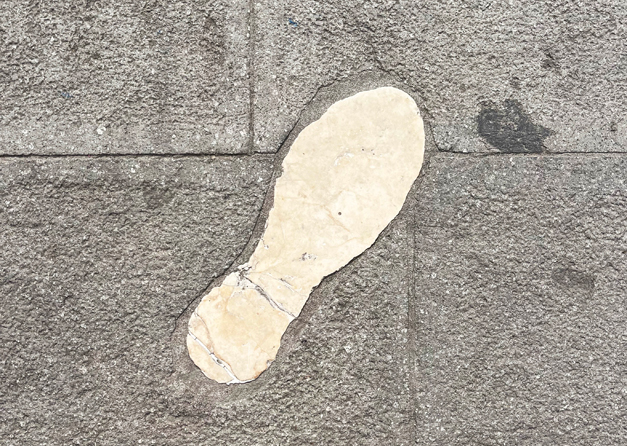
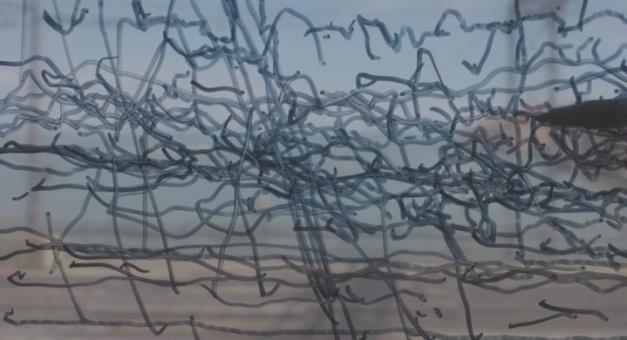
A foothold is a place of security, a position tentatively sought out and tested for stability; its ability to hold firm without yielding to your weight, shifting, disintegrating, tipping you off balance. It is the physical act of finding purchase in the world around you. A foothold also provides the foundation for a moment’s rest, a pause between movement: an exhalation. Artists Freya Gabie and Neville Gabie have been negotiating this precarious city - neither solid ground, nor purely water - developing a series of responses as part of an ongoing project which will be further developed through the summer of 2026.
With a background in sculpture, Neville Gabie’s practice has always been driven by working in response to specific locations or situations caught in a moment of change. Highly urbanized or distantly remote, his work is a response to the vulnerability of place. Gabie’s interest is in establishing a working relationship within a particular community as a means of considering its physical, cultural or emotional geography. Born in Johannesburg, South Africa – MA in Sculpture at the Royal College of Art, London 1986/88
Freya Gabie studied sculpture at Chelsea College of Art and the
Royal College of Art.
Freya is a multi-disciplinary artist, with a focus on sculpture
and drawing. She is interested in highlighting unnoticed narratives
manifest within different scenarios, places and objects. Often working
with the familiar or ordinary, her work considers what our material
culture says about contemporary society. Small, playful interactions/conversations
take place between the artist and the things around her; retelling
them in new form to reveal unfamiliar characteristics, highlight
different histories and create an altered material inheritance.

Pillars of Hope is a series of ceramic sculptures, containing smaller sculptural elements placed within or on top of the larger forms, while others carry reliefs or painted glaze drawings on their surfaces.The sculptures evolved organically in the studio while Kritzman was thinking about how large and small elements can exist together without one becoming the base, support, or decoration of the other. Kritzman was interested in creating relationships between forms that feel unstable, playful, and interdependent.
The series takes inspiration from ancient Mediterranean pottery, especially hand-built coil vessels with decorative elements that seem to contradict or interrupt the original form or function of the object. These references sparked a way of thinking through attachment, ornament, and excess.While making the works, Kritzman aimed for the sculptures to remain playful and intuitive, but also to carry a heavier or darker undertone. Their rough surfaces, openings, protrusions, and stacked elements suggest forms that sit somewhere between vessel, body, fragment, and creature.
Abraham Kritzman lives and works between Tel Aviv and London. He studied at the Bezalel Academy of Arts and Design Jerusalem before completing an MA in Painting at the Royal College of Art in 2014. His multidisciplinary practice spans painting, sculpture, printmaking, and ceramics, exploring intersections of memory, material, mythology, and states of introspection. Drawing from research-based encounters with historically and culturally charged locations, his works construct fragmented narratives in which solitude, symbolism, and tactile processes converge.